
How to Remove & Fit a Car Battery
The removal and fitting of a vehicle battery is usually a simple task that can be done on your own with basic tools you likely have on hand.
Note: To prevent reverse polarity, the arrangement of the negative and positive terminals should be noted before removing the old battery. The negative terminal will be connected to the earth cable which, in turn, is connected to the engine and chassis.
Steps to follow:
- Remove any protective parts like plastic housings and sleeves.
- Disconnect the earth cable first to prevent sparks caused by accidental short-circuiting between the positive terminal and the vehicle body. Disconnect the positive cable from the terminal post and then remove the battery hold-downs.
- Finally, remove the battery from the vehicle.
- Inspect the battery compartment for corrosion. Clean and repair where necessary. Inspect the brackets, hold-downs and terminal clamps for rust and damage, and remove any surface rust and dirt. Use a wire brush to clean corrosion from the battery tray and clamps.
- Carefully place the new vehicle battery in the tray and ensure it is properly seated. Make certain the positive and negative terminals are in the same position in relation to the earth cable (as noted during the removal procedure). This procedure ensures correct polarity. Replace the battery hold-downs but do not tighten at this point.
- Before connection, check the correct polarity of the cables again. Connect the positive cable first, and then connect the earth cable.
- Take care that the terminal clamps are firmly fitted to eliminate contact interruptions due to vibrations. When connecting the terminal clamps, care must be taken that the battery terminals are not damaged by torsion or other mechanical stresses. Coat the terminals and cable clamps with petroleum jelly or a terminal protector.
- The hold-down nuts can now be tightened securely. Do not overtighten.
- Replace any protective parts like plastic housings and sleeves.
- Remove any tools from the engine compartment.
- Installation is now complete. To ensure the battery is installed correctly, turn ignition key on and crank the engine.
How to Use Jumper Cables
We’ve all experienced it: you go away on holiday for a couple of weeks or leave the car lights on. Then, when you try to start the car, nothing happens. When your car battery is dead, you need two things: a set of jumper cables, and an obliging person with a car and a working battery.
When connecting the jumper cables, do the following for both vehicles before connecting the jumper cables: apply the handbrake, turn off all switches and place the gear selector in Neutral or Park.
STEP 1: Connect one cable to the positive post of the discharged battery.
STEP 2: Connect the other end of the same cable to the positive post of the booster battery.
STEP 3: Connect the second cable to the negative post of the booster battery.
STEP 4: Make the final connection of the second cable to engine block or chassis of the stalled vehicle.
STEP 5: Crank the engine of the stalled engine.
STEP 6: To remove cables, reverse this exact procedure.
Always refer to the owner’s manual for the correct jumpstarting procedure for your vehicle.
How to Test if your Car Battery is Flat
Do you remember when you last had your car battery checked? The summer heat and winter cold take a big toll on your car’s battery, which could wind up leaving you stranded.
If it’s been a while, or it has been a rough season for your battery, now is the time to have it tested.
Avoid testing the battery directly after the car has been driven, since surface charge in the battery might give erroneous voltage readings and you might then think the battery is OK, when in actual fact it is not. Rather let the vehicle stand for a while before testing or run some of the larger electrical consumers like lights or heating blower for a couple of seconds, to get rid of surface charge.
Select the DC voltage measurement function on your multimeter, then consult the user manual for instructions.
- If your multimeter does not have an auto-ranging function, select the 20V DC (Test one battery only)
- Touch the red probe to the positive terminal, and the black probe to the negative terminal.
The resting voltage should ideally be no lower than 12.6V. When a battery goes down to 12.2V, it’s actually only 50% charged, and below 12V it’s classed as discharged!
If you measure less than 12.6 volts, use a Smart Charger to charge the battery, without disconnecting it, to avoid any risk to the vehicle electronics.
When not using a Smart charger, remember that disconnecting a battery without a slave battery in place is not advised, as modern cars may lose memory settings.
If in doubt, always refer to the instruction manual.
Battery analysers are recognised worldwide as the standard for determining battery condition and provide a host of benefits:
- Quick & accurate battery diagnosis.
- Savings on time and money with improved testing productivity.
- Increased customer turnaround times.
- Reduced incidents of invalid warranty claims.
- Improved customer satisfaction.
- Fast, accurate test results on suspect batteries.
- A printout of results for the customer.
- Indicating when to replace weak batteries before they fail.
How to Know which Willard Battery is Needed for your Vehicle
The majority of batteries found in most modern-day vehicles are lead-acid and offer a very good compromise between reliability, usability, robustness, availability and price.
Absorbed Glass Mat (AGM) batteries, along with Flooded (or Wet Cell), Gel Cell, and Enhanced Flooded Batteries (EFB) are sub-sets of lead-acid batteries.
AGM and EFB batteries are characterised by their high performance and thanks to advances in battery technology, they need less maintenance and are more reliable than 10 years ago.
Conventional flooded batteries are the most common and economical lead-acid chemistry and are suitable for conventional vehicles. Some are classified as SMF (Sealed Maintenance Free), where no maintenance of the electrolyte levels is required.
Enhanced Flooded Batteries are referred to as EFB’s and are designed for Start-Stop applications. They are different to Conventional Batteries in that: They cycle better, they accept charge better, and they have a wider operating range of temperatures.
Increasingly used as replacements for conventional batteries, EFB’s must only be used in vehicles whose electrical systems are designed for EFB’s or Conventional Batteries.
Absorbed Glass Mat Batteries are referred to as AGM’s and are valve regulated lead acid (VRLA) batteries. Valve Regulated batteries are equipped with a pressure release valve for safety and oxygen recombination. AGM’s offer better performance than Conventional Batteries in that: They cycle better, they accept charge better and they have no water loss.
AGM’s must only be used in vehicles whose electrical system was designed for these batteries.
How to Recycle your Willard Car Battery
Although batteries are not thought to be as harmful as they once were, it’s still important to environmentally minded consumers to recycle batteries responsibly.
Batteries still contain substances that can be harmful if not disposed of properly. The good news is that lead acid battery recycling is one of the most exceptional environmental success stories of our time.
Potentially a noxious product that contains substances that can harm the environment, Willard Batteries encourages the recycling of these scrap batteries.
The life cycle of a Lead-Acid battery follows a continuous, closed loop. The typical new lead-acid battery is 99% recyclable and when a scrap battery is collected and returned to Willard Batteries, its lead and plastic are reclaimed and directed to new battery manufacturing.
Consumers can return their scrap battery when they install a new battery, or for more information, they can phone 0860 12 00 12.
DEFINITIONS OF BATTERY TYPES
There is often confusion when battery definitions are used to explain various aspects of the lead acid battery eg. sealed, maintenance free and other descriptive terms. The explanation of terms below is based on definitions contained in the IEC (60095-1 :20U6) specification for lead acid starter batteries and is meant to provide clarity in terms of the various terms used to describe batteries.
Definition for vented (flooded) battery
This is the most common of automotive battery types. This type of battery has a cover with one or more openings through which gas generated by the battery may escape. A battery may also be fitted with tamper—proof plugs to prevent internal access to the battery but will still have an arrangement to allow gas generated by the battery to escape. The battery has “free” electrolyte which means that the acid moves freely within the battery.
Valve regulated (with gas recombination) battery
A secondary battery that is closed under normal conditions and has an arrangement that allows the escape of gas if the internal pressure exceeds a predetermined value. The battery cannot normally receive an addition of water or electrolyte. In this type of battery, the electrolyte is immobilised. This means that the acid is held in either a gel or a glass mat structure.
Sealed battery
The valve regulated battery is often called a sealed battery because no addition of electrolyte or water is possible. However, the battery will have a pressure release vent to allow for the escape of gas generated by the battery.
Low water loss
Vented starter batteries may be designated as “low water loss” according to the IEC specification if the water loss of the battery is less than 4 grams per amp hour.
Very low water loss
Vented starter batteries may be designated as “very low water loss” acoording to the IEC specification if the water loss of the battery is less than one gram per amp hour.
Maintenance free
Some specifications use the term “maintenance free” to describe a battery that has a water loss below a certain level. The IEC specification does not use this term, but rather uses the terms low and very low water loss.
12 VOLT CELL LAYOUT

SPECIAL FEATURES
- One piece DIN type cover
- One piece flat top cover
- Single cell lids with exposed connectors
- Polypropylene container
- With handles
- 9mm Clip on side hold-downs optional
- With clip on shoulders
Terminal Type A

Terminal Type B

CONTAINER HOLD-DOWNS
B0

No bottom hold-downs
B1

10.5 front, back & ends
B3

10.5 front, back & ends
B4

19 front, back & ends
B5

10.5 front, back & 29 ends
B6

29 ends
B13

19 & 10.5 front & back, 29 & 10.5 ends
EXAMPLE: B5. 2. 4
(10.5 front & back & 29 ends)
B5 = Container Hold-down
2 = One piece flat top cover
4 = Polypropylene
For a battery to remain in good working order, it should be maintained in a fully charged state by the vehicle’s charging system. Where a battery is used as a means of alternative power, it is generally charged by means of an independent charger or rectifier which supplies controlled direct current (DC).
An independent charger is also used to charge motor vehicle batteries that have become discharged due to faulty alternators, charging systems or if left unused for prolonged periods.
If the following hints are adhered to, a battery will provide extended and trouble free service.
Do’s
- Store batteries in a clean and dry area (in order to prevent deterioration).
- Store batteries in a fully charged state. (12V Battery above 12.4V).
- Ensure a correct polarity connection when recharging and fitting.
- Follow proper recharging schedules to prevent overcharging. Ensure charging is conducted in a well ventilated area.
- Ensure that the battery is always clean and dry, with the terminals coated with petroleum jelly (vaseline) or proprietary terminal protectors. Do not use greases which may contain metal additives.
- NB: Practice stock rotation and use a first—in, first-out system at all times.
- Always wear protective clothing when working with batteries.
Don’ts
- Do not store batteries in a discharged state.
- Do not test batteries by shorting across terminal posts with wire, spanners, etc.
- Do not allow open flames or sparks near a battery as it could explode (batteries give off flammable gasses).
- Do not use a single spanner to loosen or tighten the terminal clamp as this could damage the post lid seal. Use a spanner to the nut and a second spanner to the bolt.
- Do not use the starter motor to propel the vehicle or leave the vehicle parked with accessories switched on for extended periods.
- Do not lean over a battery when charging or testing.
- Do not put any metal objects on top of a battery.
The following procedures can be used for the removal and fitment of an automotive battery:
Battery Removal:
- Before removing the old battery, take note which terminal Pos+ or Neg — is connected to the ground cable. The grounded cable is usually connected to the engine or chassis.
- Disconnect ground or negative (—) cable first. This will prevent sparks caused by accidental short circuiting.
- Disconnect the positive cable forrn the terminal post and then remove the battery hold—downs.
- Finally remove the battery from the vehicle.
Battery Service and Maintenance:
- Inspect the battery tray, hold—downs and clamps. Replace any items damaged by excessive corrosion.
- Use a wire brush to clean corrosion from battery tray and clamps. Clean all corrosion from tray, hold-downs and cables. Rinse thoroughly with clean water. Severely corroded components should be washed and neutralised by using a solution of Bicarbonate of Soda mixed with warm water (10 grams, or 1 tablespoon to 1 litre of water).
- Using a post and clamp cleaner, clean both battery terminals and the inside of both cable clamps until they have a bright metallic shine. The cleaning ensures good electrical contact.
Battery Fitment:
VERY IMPORTANT STEP
- Carefully place the new battery in the tray making certain the (+) and (-} are in the same position in relation to the grounded cable(as noted in step 1). This procedure ensures correct polarity. Replace the battery hold-downs but do not over tighten at this point.
- Follow the reverse of the procedure in the removing the battery. Connect the positive cable first and then connect the grounded cable. Make sure both cable connections to the terminals are tight. Coat the terminals and the cable clamps with petroleum jelly or a proprietary terminal
- Do not use grease which may contain metal additives.
- The hold-down nuts can now be tightened securely. Do not over tighten.
- Installation is complete. To ensure battery is installed correctly, turn ignition on. If battery is properly installed, the ammeter (or charge indicator in some vehicles) will show discharged. Crank the engine. Once the engine is running, the ammeter or charge indicator light should
- function correctly.
- It is advisable to always have the vehicle’s charging system checked after fitment of a new battery.
Sulphuric Acid (Sulphuric Acid Emergency Procedures)
- Skin contact: Immediately drench the affected area with clean water and remove any contaminated clothing. If any soreness or irritation persists seek medical advice.
- Eye contact: Immediately wash out the eyes with clean water until initial burning subsides. Do not use eye drops but do seek prompt medical attention.
- Ingestion: DO NOT induce vomiting but make patient drink as much water or milk as possible, followed by milk of magnesia, beaten eggs or vegetable oil and seek immediate medical attention.
- Spillage: Small spillages can be quite simply dealt with by rinsing away with plenty of water and neutralizing using Bicarbonate of Soda mixed with water (10 grams Bicarb to 1 litre water).
- Burns: Apply a dry sterile dressing and seek medical attention.
Sulphuric Acid Handling Tips
Sulphuric acid (H2SO4) is contained in batteries.
Battery acid is a poisonous and corrosive liquid, which will cause burns and irritation to the skin and eyes. Take precautions when charging as sulphuric acid is given off in a fine mist.
- Always handle batteries with care and keep upright.
- Disposal: Suitably labelled, acid resistant containers should be used for transporting, neutralizing and disposal of sulphuric acid.
- Use eye protection and protective clothing where there is any risk of acid splashing or spillage.
- Keep, charge, check and test batteries in a well ventilated area.
- Do not place tools or conductive objects on top of batteries.
- Before using a battery charger consult manufacturer’s literature.
- Remember to switch the charger off before connecting or disconnecting the battery.
Emission of Gases
Hydrogen and oxygen can be generated and emitted.
An explosive atmosphere is created if the concentration of hydrogen in air exceeds 4%.
- Keep, fill, charge, check and test batteries in a well ventilated area.
- Avoid sources of ignition close to batteries:
- In particular:
- No smoking
- No naked flames
- Switch off current before making or breaking electrical connection. Avoid sparks caused by accidental short circuits.
Emergency Procedure for Treating Electric Shocks
- Electric Shock: Immediate action is essential in cases of severe electrical shock as the nerves controlling breathing and heart action may be affected. Do not delay treatment by calling for a doctor; this should be done quickly if help is available or when the casualty recovers.
- Make sure it is safe to approach casualty. If the casualty is not clear of the electric source, switch off the power. If this is not possible, attempt to separate the casualty from the conductor using a dry, insulating object (wood, rubber, brick, thickly folded newspaper, cardboard) and try to push or pull the casualty clear of contact. Do not touch casualty with bare hands.
- Apply artificial respiration if necessary. Seek medical attention thereafter.
- Explosion: Seek any necessary medical attention and remember that sulphuric acid may have been ejected.
Electrical Energy Handling Tips
Electrical energy can be supplied from batteries and charging equipment.
*Burns may occur from the heating effect of tools and conductive objects in contact with live battery terminals or conductors. In addition, sparks and molten metal may be ejected and combustible materials, notably the gaseous fumes, ignited to cause potentially lethal explosions.*
*It is possible to receive a severe electric shock from charging equipment and from a number of batteries connected in series i.e. five or more 12 volt batteries (+60 volt nominal).
- Before using conductive tools on a battery, remove metallic personal adornments from the hands and wrists.
- Before working on a vehicle’s electrical system, blow across the terminals and the vent holes to disperse any fumes and disconnect the battery where there is any risk of accidental short circuits. Always disconnect the earth terminal from a battery first and connect it last to prevent short circuiting.
- Use eye protection and protective clothing where there is any risk of acid splashing or spillage.








CORPORATE SOCIAL RESPONSIBILITY
In terms of its social responsibilities, Willard Batteries has a history of giving back to the community. It made a significant contribution with the Go Green, Go Willard campaign which helped raise funds for Food & Trees for Africa and which helped plant thousands of trees in schools and other areas across South Africa .
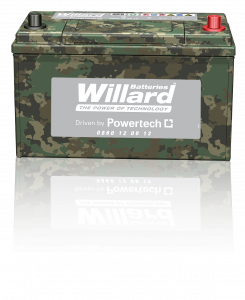
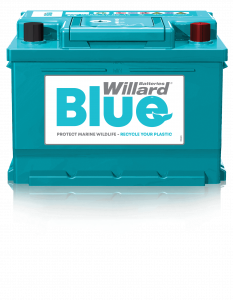
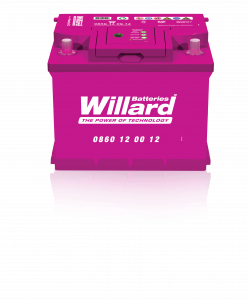
Willard Batteries has continued to give back through its limited edition battery range, these previously including: